How to Find a Seersucker Suit
That Won't Scream 'Ice Cream'
By VANESSA O'CONNELL
Staff Reporter of THE WALL STREET JOURNAL
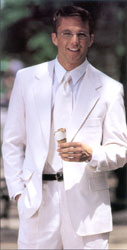 Nothing's quite as hit-or-miss as a seersucker suit. It can make a man look effortlessly sophisticated, ready for a bourbon at the Kentucky Derby. Or it can make him look like he should be selling Eskimo pies.
Seersucker suits are intimidating enough, in fact, that plenty of men avoid them altogether. But this spring, the fashion industry's pushing the look hard: For the first time in years, French designer Hermes has a version of the American classic (price: $2,800 and up), while big retailers from Barneys to Saks Fifth Avenue are varying the theme, selling trousers without the jacket and trading the traditional blue-and-white look for stripes in beige, yellow, lime and orange.
Hoping to avoid the ice-cream man look, we ordered a selection ranging from a la carte pants to complete suits. We passed on those yellow-striped numbers, pitting modern takes on the classic blue-and-white (pants only, cashmere blends) against suits from some of the oldest makers in the business. Then we threw a seersucker party, inviting fans and skeptics alike and asking our hip 40-year-old cellist friend, Garo, to model the designs.
The trousers from New York-based retailer Barneys were plenty cool -- but unfortunately, ordering them nearly made us lose ours. To be fair, it was partially our fault: When our credit-card address didn't match our phone number, our representatives turned frosty, and it took us three tries to finally get our pants. When we finally got these $240, Italian-made trousers, our tester found them a bit snug, though the material was soft and crisp.
Still, our panel thought that for the full effect, Garo would need a jacket -- and they had high hopes for the $1,400 suit from Hickey Freeman. (We ordered all suits in 40 regular, which came with size 34 trousers). Indeed, this had beautiful details, including hand-stitched buttonholes. But something was amiss: Its fabric was thick and smooth, and when we read the catalog's fine print, we discovered it was actually a cotton-cashmere blend. "It's faux seersucker," said panelist Eric, a doctor.
Traditional seersucker, of course, is 100% cotton, with a thin, crinkly feel. When the fabric was introduced -- Brooks Brothers says it brought it to the U.S. in the 1830s to make frock coats -- many wealthier wearers rejected the rumpled look. Still, it was popular in the warmer Southern states, and during the Depression, seersucker suits caught on because they were cheap and washable. The whole wrinkle thing got ironed out by the 1950s, when clothing makers began adding synthetic fibers. But that hasn't necessarily made it easier to look great. Because this fabric is soft, it must hang just right. Even slight alterations can disturb the vertical lines. Finally, if the suit's too baggy, you look like you're dressed in a dish towel.
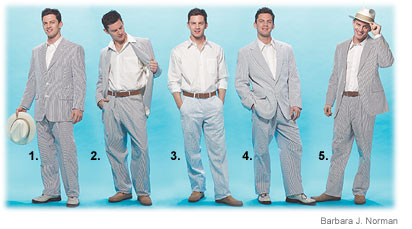
Suits us: Seersuckers from 1) Jos. A. Bank Clothiers; 2) Hickey Freeman; 3) Barneys New York; 4) Hunter & Coggins Clothing Co.; and 5) Brooks Brothers.
That was the case with the suit we ordered from Jos. A. Bank. It was a bargain at $200 and the fabric was classic, but the pants' full cut seemed a bit baggy. The three-button jacket we chose, meanwhile, had a long cut and stylized look, with padded shoulders and skinny lapels. The overall effect? A bit too gangster-flick slick. "Like Joe Pesci in a suit that fell off the back of a truck," said Garo.
So we were down to two suits -- from some of the oldest names in seersucker. Brooks Brothers' modern version, about $300, felt like the real thing. It fit Garo -- the jacket laid flat, the pants fit well -- and would require almost no alterations. Still, other panelists called the pant leg too full and boxy, and noticed the lining was a touch heavier than they expected: "You might sweat a lot," Eric said.
Our final pick was from Haspel, a brand widely credited with popularizing these suits. Though these suits are widely available, we got ours from the Web site of North Carolina clothier Hunter & Coggins. Our panelists called it simple, unaffected, and "devoid of modernisms." The fabric was light, but with body and texture. The two-button jacket had the best fit, and its trim-cut pants looked good not only on Garo, but on Eric, a taller and leaner panelist.
The only problem: The suit arrived with a discolored shoulder. When we called the store, proprietor Jim Hunter offered to pay for dry-cleaning -- we passed -- and then offered to send us a second one. The new model was perfect, both crisp and crinkled at the same time. "Now, this is what seersucker is supposed to be," said Eric. It's our Best Overall -- and, at $275, our Best Value.
Hunter & Coggins Clothing Co.
Haspel seersucker suit, $275
800-343-9396
www.hunterandcoggins.com
Quality: Best Overall, Best Value. Traditional, 100% cotton suit with good body, pucker -- and the right size stripes. Narrow, double-pleat pants. Lined jackets, size short to extra long.
Shipping Cost/Time: We paid $30 for next-day shipping, and ours arrived in a couple of days.
Return Policy: Return, unworn, within a week of receipt. Store pays return shipping.
Phone/Web Experience: This Asheville, N.C., store's modest site didn't accept our AmEx card. But staff was courteous, and the owner even included handwritten thank-you notes.
Comments: A warning: Hunter & Coggins doesn't have a huge inventory but offered to order any size we wanted from the distributor. Also comes in tan-and-white.